The Blind Seeing Translator: Oedipus, King of Thebes and the Tragedy of Misunderstanding
Have you ever noticed that a text which has been translated into dozens of languages, included in textbooks, and repeatedly reinterpreted across fields ranging from psychology to cinema, from literature to popular culture, is in fact about a bad translator? Oedipus, King of Thebes is most often associated with the inevitability of fate; yet, this story is less a tragedy of fate than a tragedy of misreading and misunderstanding.
Oedipus, King of Thebes is one of the most famous tragedies of Ancient Greece. The play takes place in the city of Thebes, which is suffering from a devastating plague that claims countless lives. The people turn to their king, Oedipus, for help. Oedipus is portrayed as a just, powerful ruler who cares deeply for his people. In an effort to save the city, he consults the gods and receives the following oracle: “This city will not be freed from the plague unless the murderer of the former king, Laius, is found and punished.” Oedipus swears to uncover the murderer, publicly cursing both the culprit and anyone who may have aided him, unaware that he is preparing his own downfall. He summons the blind prophet Teiresias, who initially refuses to speak, knowing how unbearable the truth will be. When forced to speak, Teiresias delivers the devastating revelation: “You are the murderer you seek.” Oedipus rejects this claim, accusing Teiresias of deception. Yet, as events unfold, the truth slowly comes to light. At Oedipus's birth, a terrifying prophecy had already been declared: “This child will kill his father and marry his mother.” In an attempt to prevent this fate, King Laius orders the infant's feet to be pierced and the child to be abandoned on a mountain. The baby survives, is found by a shepherd, and is given to another king, who raises him as his own. Years later, Oedipus learns of the prophecy. Believing the family who raised him to be his biological parents, he flees the city to protect them from harm. On the road, he quarrels with an old man and kills him, unaware that the man is his real father, Laius. Oedipus then arrives in Thebes, defeats the Sphinx through his intelligence, and is celebrated as a hero. He is rewarded with the throne and marriage to Queen Jocasta, not knowing that she is his biological mother. Years later, when the full truth emerges, Jocasta takes her own life. Oedipus, overwhelmed by pain and remorse, blinds himself, abdicates the throne, and goes into exile.
The prophecy that shapes Oedipus's life appears, at first glance, strikingly clear; yet, it is precisely this illusion of clarity that lays the groundwork for disaster. Much like a problematic source text, the prophecy is contextless, timeless, and polysemous. Oedipus does not perceive this multiplicity of meanings as something to be interpreted, but rather as an equation that must be solved quickly. What he fails to recognize is a crucial linguistic fact: in Ancient Greek, kinship terms are not fixed but contextual. The term pater (πατήρ) does not refer solely to the biological father; it can also denote a protective figure or a form of male authority through which lineage is established. Similarly, meter (μήτηρ) does not signify only the woman who gives birth, but may also encompass the woman who raises and cares for a child. When biological parenthood needs to be emphasized explicitly, more specific terms such as genetor (γεννήτωρ) are used. In other words, “father” and “mother” are not as stable or biologically anchored as they are in many modern languages. The tragedy of Oedipus begins precisely here. While reading the prophecy, he fails to account for this contextual flexibility. He equates “father” solely with the man who raised him and “mother” solely with the woman who nurtured him. Yet, when read through the eyes of a translator, the prophecy is a text that demands reinterpretation rather than blind acceptance. Oedipus does not do this; instead, he treats the prophecy as an untranslatable, interpretation-resistant truth. If we consider the prophecy as the source text and Oedipus's actions as the target text, the catastrophe that follows can be understood as a classic case of faulty equivalence. In translation theory, particularly in Eugene Nida's discussion of equivalence, equivalence does not mean word-for-word correspondence, but the reconstruction of meaning within context. Oedipus, however, insists on formal equivalence, reducing “father” and “mother” to singular, fixed roles. This incorrect matching does not result merely in a translation error, but in a catastrophic semantic collapse.
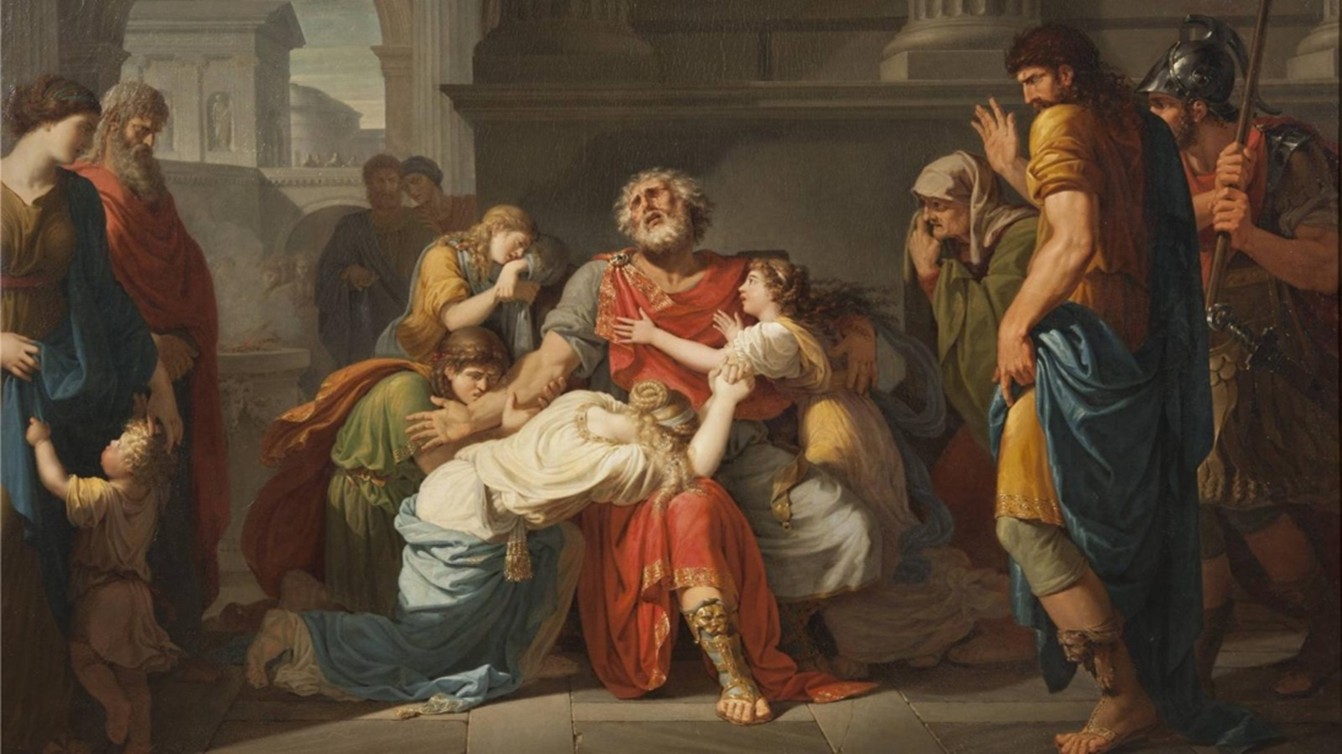
Figure 1. Benigne Gagneraux, The Blind Oedipus Commends His Family to the Gods, 1784. Nationalmuseum, Stockholm.
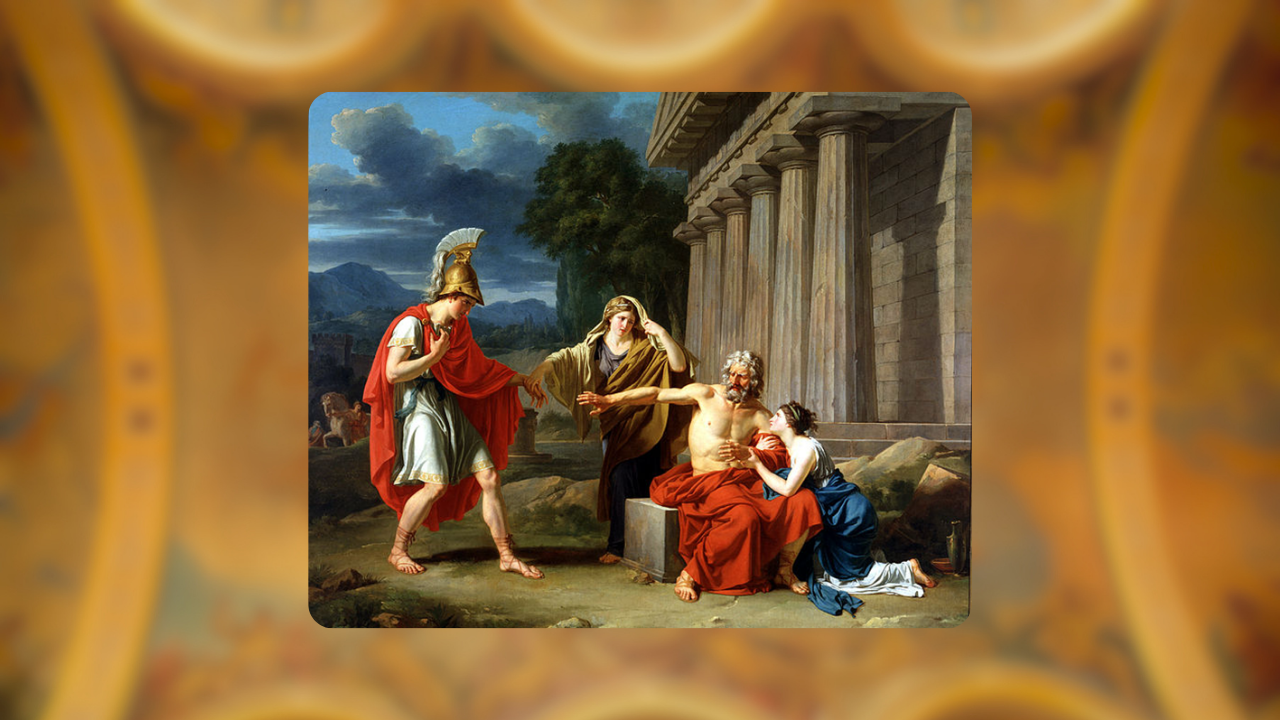
At this point, Oedipus becomes the metaphor of the blind seeing translator. His eyes are open; he hears words, recognizes sentences, and believes he understands them correctly, yet he cannot perceive meaning. Like a translator who faithfully renders words while ignoring context and culture, Oedipus sees the language of the prophecy but fails to read its meaning. This interpretive blindness has also been translated into visual form. In eighteenth-century painting, Oedipus often appears as a figure through whom the verbal tragedy of Sophocles' text is rendered into another semiotic system. In Benigne Gagneraux's The Blind Oedipus Commends His Family to the Gods, Oedipus no longer sees, yet he is depicted as fully aware of the weight of truth. In Jean-Antoine-Theodore Giroust's Oedipus at Colonus, knowledge remains, but the power to act has vanished. These visual representations function as visual translations of the tragedy, foregrounding not fate, but the devastating consequences of delayed understanding (see Figures 1 and 2).
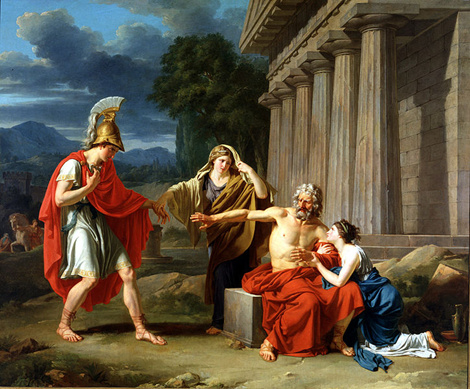
Figure 2. Jean-Antoine-Theodore Giroust, Oedipus at Colonus, 1788. Dallas Museum of Art.
Oedipus's self-blinding, therefore, is not merely a dramatic punishment; it is a belated realization. It marks the moment he understands that seeing is not enough; reading, interpreting, and remaining open to ambiguity are essential. Translation awareness requires tolerance for uncertainty and the willingness to circle meaning rather than fix it prematurely. Oedipus, unable to endure ambiguity, closes meaning too early. Perhaps this is why the story continues to unsettle us. We, too, often behave like Oedipus: We assume we understand without translating, ignore context, and become blind seeing translators ourselves. The tragedy of King Oedipus reminds us that meaning is not something given, but something that must be constructed responsibly - and that sometimes catastrophe arises not from mistranslating a sentence, but from failing to translate meaning at all.
References
- Dallas Museum of Art. (n.d.). Collections. Open-access statement available at https://dma.org/art/collection
- Dallas Museum of Art. (n.d.). Oedipus at Colonus. Retrieved April 18, 2026, from https://dma.org/art/collection/object/3311012
- Nationalmuseum. (n.d.). The Blind Oedipus Commending His Children to the Gods. Retrieved April 18, 2026, from https://collection.nationalmuseum.se/en/collection/item/17831/
- Nationalmuseum. (n.d.). Rights and reproductions. Retrieved April 18, 2026, from https://www.nationalmuseum.se/en/explore-art-and-design/images/rights-and-reproductions
- Sophocles. (2012). Kral Oidipus (B. Tuncel, Trans.). Türkiye İş Bankası Kültür Yayınları. (Original work published 5th century BCE)
AI Use
- AI was used only for language editing and formatting assistance during manuscript preparation.