
Translation, Localization ,Internationalization, and Globalization
In today’s world, texts are no longer written only to be read. They are produced to travel, adapt, and live on in other cultures. At the center of this movement lies translation, acting not merely as a linguistic transfer, but as the strategic bridge connecting global reach with local cultural relevance. Yet contemporary translation practices go far beyond the traditional idea of transferring meaning from one language to another. Today, translation cannot be discussed without considering three closely related concepts: internationalization, localization, and globalization. They all represent a distinct stage and mindset within translation practice. Their relationship is not linear but rather part of a broader cultural design process in which language, culture, and context constantly interact.
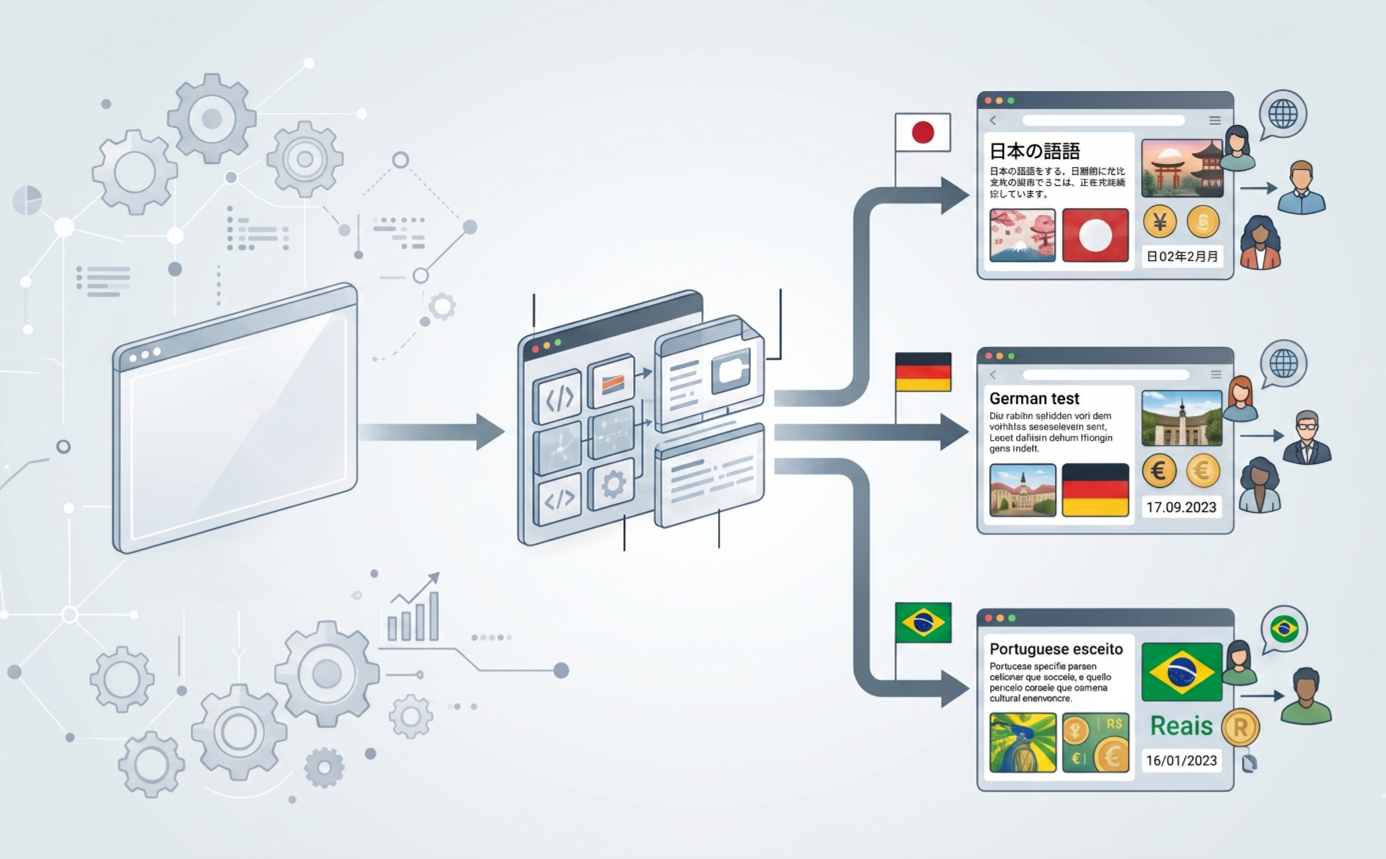
Internationalization(I18n): Preparing the Ground for Translation
Internationalization refers to the stage at which a text, product, or digital content is prepared for use in multiple languages and cultures before translation even begins. The goal is not to remove culture entirely, but to avoid limiting content to a single cultural framework. At this stage, international standards such as Unicode are commonly used to ensure that different writing systems and characters can be handled consistently across languages. Elements such as date formats, measurement units, symbols, culturally specific references, and layout choices are reconsidered in advance. This makes the text more flexible and easier to adapt later, creating a translation-friendly structure that allows translators and localization specialists to work more effectively. In this sense, internationalization shifts translation from a purely linguistic task to a strategic design decision, as the way a text is structured directly influences how it will be translated and localized in the future.
Localization(L10n): Meeting the Target Culture
Localization, a highly visible and culturally sensitive phenomenon, involves adapting content not only linguistically but also culturally, ensuring that it feels natural and meaningful to the target audience. Localization goes beyond words: humor, tone, visual elements, color choices, and forms of address are all reconsidered. In this process, the translator becomes an active cultural mediator. The task is no longer simply to convey what is said, but to consider how it will be perceived. For this reason, localization requires a high level of cultural awareness and responsibility. In digital contexts such as websites, mobile applications, and video games, translation without proper localization often results in texts that feel distant or awkward. When localization is ignored, communication fails even if the language is technically correct.
Globalization(G11n): The Broader Horizon of Translation
Globalization is the widest framework encompassing both internationalization and localization. It refers to the global circulation of texts, products, and ideas across borders. Within this process, translation becomes a fundamental tool of global communication. However, globalization does not mean making everything uniform. On the contrary, global reach is only possible when local differences are respected. In this sense, translation does not erase cultural diversity; when done thoughtfully, it helps preserve and communicate. Translation thus operates both as a gateway to global markets and as a mechanism that maintains cultural specificity within global exchange.
The concepts of localization, internationalization, and globalization have significantly reshaped the role of the translator. Today, translators are not merely language experts; they are cultural specialists, responsible for managing meaning, context, and user experience. This shift transforms translation into a strategic form of cultural communication. Translators decide what should remain unchanged and what needs adaptation, making choices that carry cultural and ideological implications. As a result, contemporary translation should be understood not as neutral transfer, but as a conscious act of re-creation. Every text that enters global circulation today passes through a translation process whether visible or invisible. Internationalization prepares content for adaptation, localization brings it into contact with specific cultures, and globalization expands its reach worldwide. Translation stands at the intersection of these processes, acting as the key facilitator of global communication. For this reason, translation is no longer just a linguistic skill. It is a complex practice that requires cultural awareness, strategic thinking, and ethical responsibility. In a globalized world, genuine understanding across cultures is only possible through translation that recognizes and respects difference.
Referanslar
- Al-Athwary, A. A. H. (2025). The interplay of globalization, localization, and translation in shaping the linguistic landscape. Journal of Research in Language & Translation.
- Bajelani, S. (n.d.). Internationalization in localization. ProZ.com. https://www.proz.com/translation articles/articles/3058/1/Internationalization-in-Localization-
- Evaluating the concept of localization in terms of academics and the translation sector. (2022). Istanbul University Journal of Translation Studies. https://dergipark.org.tr/tr/pub/iuceviri/issue/71211/1096056?utm_source=chatgpt.com
- GILT: Globalization, internationalization, localization, translation. (n.d.). TranslationDirectory. https://www.translationdirectory.com/article127.htm
- Internationalization & localization strategies: A case study on Vogue. (2022). IU Journal of Translation Studies. https://dergipark.org.tr/en/pub/iuceviri/issue/75052/1177822
- Localization, internationalization & globalization: What is the difference? (n.d.). Translate.One. https://www.translate.one/localization-internationalization-globalization/
- O’Hagan, M., & Ashworth, D. (n.d.). Globalization and localization. Translation Journal. https://translationjournal.net/journal/53globalization.htm
- The journal of internationalization and localization. (n.d.). John Benjamins Publishing Company. https://benjamins.com/catalog/jial.9.1
- Translation, localization, and globalization. (n.d.). Technical Communication Body of Knowledge. https://www.tcbok.org/development/translation-localization-and-globalization/
Görsel Referans
- https://www.translate.one/localization-internationalization-globalization
Yapay Zekâ Kullanımı
- İçeriğin planlanmasında ve düzenlenmesinde yapay zekâdan faydalanılmıştır.