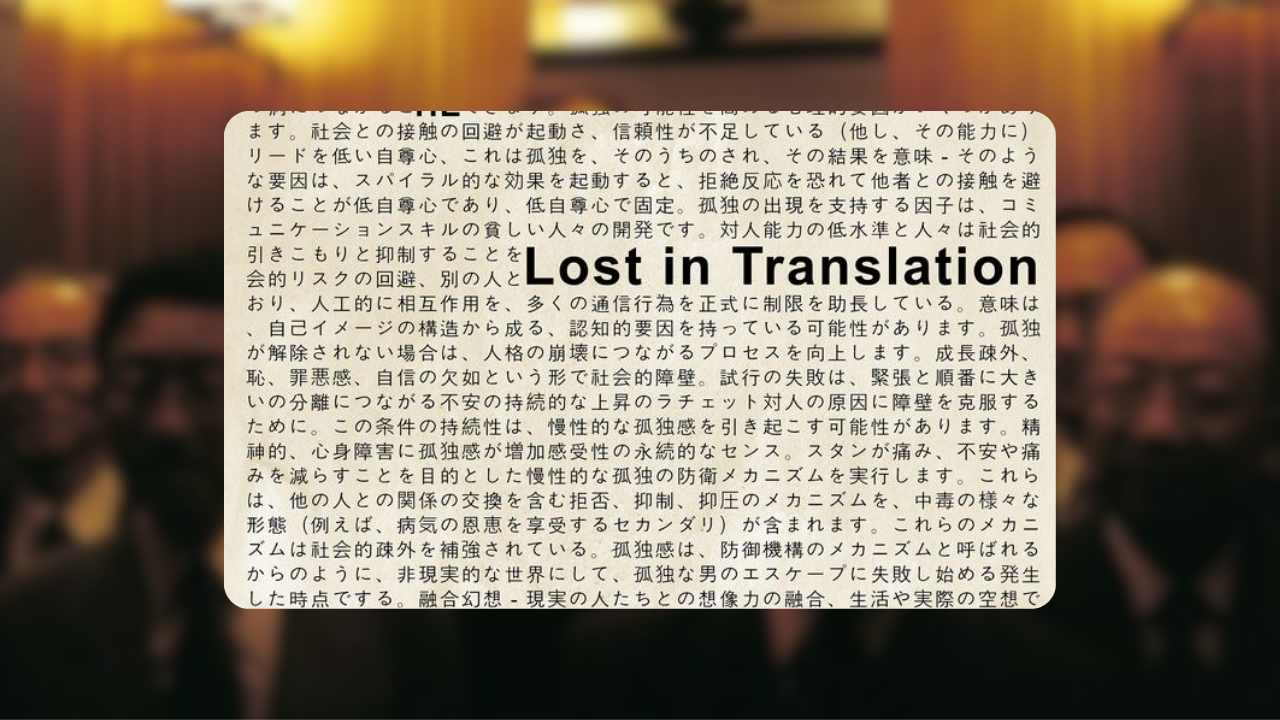
Lost in Translation or Lost by Translation?
Imagine this: you travel to a country whose language and culture you know nothing about. You step outside to explore the streets, looking around with great excitement and opening the door to a new story. You are surrounded by signs whose pronunciations you do not even know; you try to find your way and perhaps, without realizing it, attempt to communicate with locals. On this journey, you have only a map and the translation applications you frequently use. But how much of this culture do you truly experience and internalize? More importantly, to what extent are the people who try to communicate with you (those who try to translate for you) able to convey the message they intend to deliver, or how effectively do you think you can convey your own message to them? When no transfer truly affects either you or the other people, do you feel a sense of unease and confusion inside your mind? Did you know that this vague feeling actually has a name? “Lost in translation” is a term that corresponds to this silent yet unsettling sensation of “something not quite fitting into place” and in fact, we may be exposed to it whenever we translate or are translated.
The concept of “lost in translation” refers to the loss of real meaning during the translation process, the failure of a translation to produce the intended effect on the target audience, or the weakening of meaning when no equivalent can be found in the target language. This concept can occur wherever people and culture exist. You may want to share a poem that deeply saddens you and takes you far away emotionally with a British friend, yet the translated version of the poem may not affect them as deeply as it affects you. Or when your Spanish friend tries to translate and explain a joke that makes them burst into laughter, you may not find it equally funny. It is precisely in these moments that we feel we are “lost in translation.”
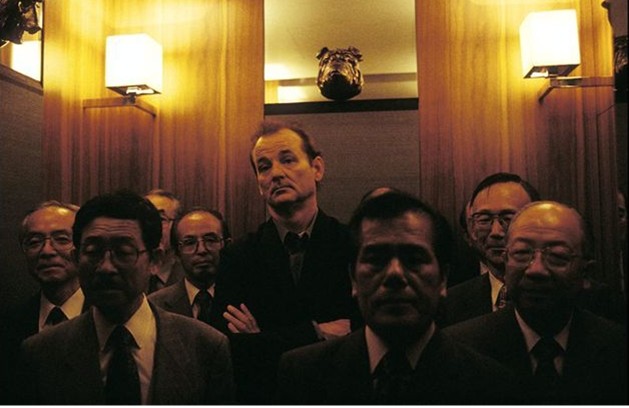
For this article, I chose a specific and special movie for the best description of this situation. Sofia Coppola’s 2003 cult classic Lost in Translation directly addresses this concept and draws attention to the silence that exists between two different cultures.
The main character, Bob, is a famous American actor who comes to the heart of Japan, Tokyo, for an ad shoot. Although he is warmly welcomed by Japanese people, Bob soon realizes that he has fallen into a pit of incomprehension as he attempts to communicate.
Bob’s very first moment of being lost in translation begins during the ad shoot. The Japanese director he is working with explains in detail the actions Bob needs to perform, gives instructions, gestures animatedly, and speaks at length with great care. As viewers, we listen to the Japanese director along with Bob and try to understand what he is saying, yet we encounter one of the film’s subtle and striking details: in scenes where Japanese is spoken, there are no subtitles! Like Bob, we as viewers are also strangers to what is being said. Then the Japanese interpreter enters the scene, and from that long, passionate, and multilayered speech, only a single sentence is translated. The entirety of those detailed instructions is reduced to: “Turn to the right and be more passionate.” Even Bob questions whether only a single sentence was actually said. Although he tries to do what is asked based on that one sentence, the director is dissatisfied. The director attempts to explain himself again in greater detail, yet the outcome remains futile. There is a disconnection, and no solution seems possible.
What is lost in this situation: words, or the feelings that were meant to be conveyed?
In translations involving cultural elements that reflect society, such as advertisements, things do not always go as expected. Translating a text correctly in terms of grammar does not necessarily mean that the resulting text will be fully sufficient or comprehensible in every respect. While the translator is responsible for conveying the intended message, they must also faithfully transfer the meaning, the emphasis, and the implied intentions of the original text. Omission is not a good option, and the fate of the advertisement’s impact lies in the hands of the translator.
When we return to the advertising scene in the film, it is stated that the director tells the interpreter, “This translation is very important, understood?” and the interpreter replies, “Absolutely, I understand.” The director then gives detailed instructions in Japanese, explaining that Bob should quietly notice the Suntory whiskey bottle on the table, slowly pick it up with genuine feeling, look tenderly into the camera, and act “as if he were meeting an old friend.” Naturally, the interpreter reduces all of these emotion-laden instructions to “Just turn and look at the camera,” and all meaning is instantly lost. At this point, Bob becomes the one who is lost by the translation and the one who suffers from what the translation fails to convey, as almost none of the instructions are transferred and the direction of the marketing effort is clearly misguided.
Bob asks whether the instructions were really that brief. The Japanese director once again explains, in Japanese, that tension is extremely important, that it should show customers enjoyment, and that Bob should reflect the emotions he feels while drinking the beverage. The interpreter, however, translates this merely as: “Like an old friend, and turn into the camera.” Things become even more misunderstood.
Bob tries to follow what he is told and takes a sip of the drink while saying, “For relaxing times, make it Suntory time.” The director angrily shouts, “Cut! Stop, stop, stop!” He then turns to Bob and, in a fit of anger, says “Don’t pretend you don’t understand. Did you even understand our purpose? Suntory is a very luxurious brand. The feelings conveyed by words are extremely important.
This is a very expensive brand. Try again and make the audience feel that it is a luxurious brand. Understood? Don’t act as if you are marketing a cheap product.” These sentences are conveyed to Bob by the interpreter simply as “Be a little slower.” Bob moves more slowly as instructed, and the take is cut once again.
What is the source of the problem?
One of the main issues here is not that the translation is incorrect, but rather that it is done carelessly, without sufficient attention, importance, or effort. Another point is not exactly an error, but the abundance of culture-specific expressions and the lack of equivalents for these expressions in the target language. The development of a language is directly proportional to the development of its culture, and certain expressions are unique to that culture alone (Moran, 2022, p. 1). Moreover, there are culturally loaded words whose exact equivalents, the semantic equivalents, may not exist in other languages. The concept of semantic equivalence plays a central role in the relationship between the source text and the target text, and translations may differ in terms of overall communicative content (Ervas, 2010, p. 88). At the same time, the success of a translation varies according to the density of culturally loaded words in a text. According to Moran (2022, p. 1), the more culturally loaded elements a text contains, the higher the likelihood of it being lost in translation. Therefore, we cannot attribute the phenomenon of being lost in translation entirely to the translator. A translation may not be perfect, and an exact equivalent may not always be found. However, what I aim to emphasize here is the importance of informing the person with whom communication is established, acknowledging the possibility of meaning loss, being aware of that loss, and ensuring that translators work consciously and with care. Above all, the priority should be to prevent meaning from being lost through translation.
References
- Ervas, F. (2010). On semantic and pragmatic equivalence in translation. In Theoretical issues in legal translation. 87-100. Springer
- Moran, J. (2022). Lost in translation. Journal of Classics Teaching. 2022. 1-3. https://doi.org/10.1017/S205863102200006X
Visual Reference
- https://in.pinterest.com/pin/586453182766363457/