Is Language the Map of Culture, or Its Architect?
Language does not merely label the world. It gives shape to what a world feels like. It tells us where the self lives, how time moves, what counts as knowledge, and whether reality begins from the body, from memory, or from the horizon. Translation, then, is never the transfer of words alone. It is the passage from one architecture of experience into another.
We often speak of language as though it were a map. It names places, marks relations, and helps us move through the visible and invisible structures of life. Yet a map, however useful, remains secondary to the world it describes. It records. It reflects. It follows. What if language does something more intimate and more radical? What if it does not merely chart culture, but helps build it? This question becomes especially urgent when we begin to notice that languages do not simply offer different words for the same reality. They often offer different realities of feeling, orientation, and thought. The issue is not vocabulary alone. It is form. It is a pattern. It is the hidden geometry through which a culture learns to imagine home, the self, time, and truth itself. George Lakoff and Mark Johnson’s conceptual metaphor theory gave this intuition one of its clearest formulations: abstract life is often understood through bodily and spatial experience. We do not merely speak metaphorically. We live by metaphors, often without noticing them. Asking whether language is the map of culture or its architect raises a deeper question: does it describe how a people already see the world, or does it quietly train perception, arranging inner life into recurring forms? The answer may be that it does both. Yet in its deepest operations, language seems less like a mirror than a builder.
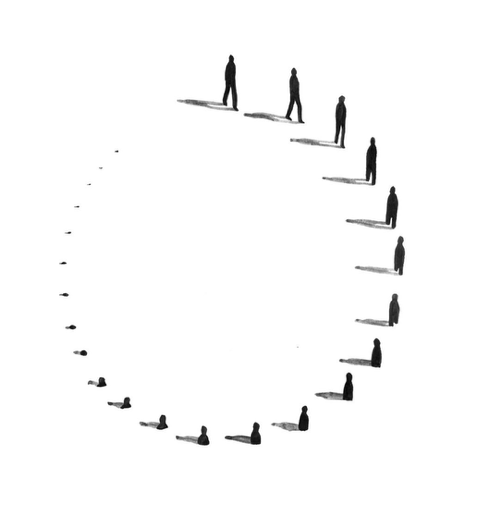
Consider first the Turkish word daire (circle). In modern usage it refers to an apartment, even when the apartment itself is square, angular, and enclosed within the rigid geometry of modern urban life. Still, the older circular image survives in the word. This is not a trivial residue. It suggests that the idea of dwelling in Turkish carries more than a material reference. It carries a psychic shape. That shape becomes even more striking when placed beside the emotional metaphors of Turkish. We say içim daraldı (I feel overwhelmed), içime attım (I kept it to myself), and içime kapandım (I became introverted). The self appears not as a line in motion but as an inner chamber, a bounded interior, a place with walls, depth, and silence. The language of feeling is architectural. The psyche is imagined as an inside. In this sense, the home is not merely where the body stays. It becomes an echo of how the self is inwardly conceived. The circle, in Jungian symbolism and in Gestalt interpretations of closure, is associated with psychic wholeness, containment, and safety. It is difficult not to hear those resonances in the emotional interiority of Turkish as well.
English, by contrast, offers a rather different spatial imagination. The apartment is a “flat,” a word that suggests surface, plane, and extension. Emotional life, too, often unfolds along directional motion: feeling down, moving forward, and falling apart. The dominant metaphors are frequently linear, vertical, or kinetic. This difference does not prove that one language is emotional and the other rational in any simple or absolute sense. Such claims are too blunt for living languages. But it does suggest that different languages may prefer different spatial grammars for inner life. One turns inward toward enclosure and protected depth. Another often projects meaning onto movement, orientation, and trajectory. Translation here becomes difficult because what changes is not only the word but also the underlying spatial logic of experience.
The same question extends from space into time. John Mbiti’s account of time in many African contexts, through the concepts of sasa and zamani, proposes a temporal imagination that is not simply a straight line rushing toward an abstract future. Time, in this view, thickens around the lived present and the depth of collective memory. What has been experienced enters a shared reservoir of meaning. The future, before it becomes lived, possesses less ontological weight. Likewise, in Aymara thought, the past is often conceived as lying in front of the speaker and the future behind, because the past is seen and known while the future remains unseen. These are not decorative metaphors. They reveal temporal philosophies embedded in language itself.

This is precisely where the first of our added examples becomes illuminating. In the Australian Aboriginal language Kuuk Thaayorre, speakers have been shown to arrange time not according to the body, as English speakers often do, but according to cardinal directions. Time is laid out from east to west, tied to the landscape rather than to the speaker’s left and right. This is astonishing not because it is exotic, but because it reveals how deeply temporal thought can be anchored in a language’s spatial habits. For some speakers, time does not follow the body. It follows the world. In English, time turns when I turn. In Kuuk Thaayorre, time stays where the sun and the land have placed it. The difference is philosophical before it is lexical.
A related insight appears in languages such as Guugu Yimithirr and Tzeltal, where spatial relations often privilege absolute directions over egocentric ones like left and right. In such systems, the body is not always the primary center from which space is organized. Orientation depends on the larger environment. One does not merely inhabit space; one remains answerable to it. This is an extraordinary counterpoint to the Turkish inwardness of iç (inside, inner-self, interiority). If Turkish often imagines the self as an interior domain, these languages remind us that not every culture takes the self as the natural center of orientation. Some grammarians teach the speaker to remain in constant conversation with terrain, horizon, slope, or cardinal direction. Language here does not simply describe position. It disciplines attention.
Taken together, these examples suggest that what we call culture is not simply stored in language as content. It is patterned in language as habit. The Turkish interior self, the circular dwelling, Mbiti’s memory-centered temporality, the Aymara reversal of past and future, the landscape-bound time of Kuuk Thaayorre, the world-orientated spatiality of Guugu Yimithirr and Tzeltal, and the evidential sensitivity of Turkish grammar: all of them show that language does more than furnish labels for an already completed universe. It arranges the coordinates through which experience becomes intelligible.
So, is language the map of culture, or its architect?
At the surface, it is certainly a map. It records inherited values, traces older forms of life, preserves gestures of memory, and carries the marks of settlement, kinship, ritual, and history. But below the surface, language behaves like an architect. It builds inward rooms for feeling. It places time on a line, in a circle, on a slope, or across a horizon. It teaches the speaker whether to trust the body, the landscape, memory, or witness. It gives abstract life a structure one can inhabit. This is why translation matters so deeply. To translate is not merely to move meaning from one code into another. It is to cross from one inner design of reality into another. A word may survive the journey, yet the world that made the word luminous may not. The translator stands, therefore, not between languages alone, but between architectures of being. Language is never just what a culture says. It is also how a culture learns to feel space, inhabit time, and recognize truth. A map tells us where we are. A building tells us how to live there. Language does both, but at its most profound, it builds.
References
-Aikhenvald, A. Y. (2006). Evidentiality. Oxford University Press.
- Boroditsky, L., & Gaby, A. (2010). Remembrances of times east: Absolute spatial representations of time in an Australian Aboriginal community. Psychological Science, 21(11), 1635–1639. https://doi.org/10.1177/0956797610386621
- Brown, P., & Levinson, S. C. (2000). Frames of spatial reference and their acquisition in Tenejapan Tzeltal. In L. Nucci, G. Saxe, & E. Turiel (Eds.), Culture, thought, and development (pp. 167–197). Erlbaum.
- Haviland, J. B. (1998). Guugu Yimithirr cardinal directions. Ethos, 26(1), 25–47. https://doi.org/10.1525/eth.1998.26.1.25
- Jung, C. G. (2017). Mandala symbolism: (From Vol. 9i of the collected works of C. G. Jung) (R. F. C. Hull, Trans.). Princeton University Press. (Original work published 1972)
- Lakoff, G., & Johnson, M. (2003). Metaphors we live by. University of Chicago Press. (Original work published 1980)
- Mbiti, J. S. (1990). African religions & philosophy (2nd ed.). Heinemann.
- Núñez, R. E., & Sweetser, E. (2006). With the future behind them: Convergent evidence from Aymara language and gesture in the crosslinguistic comparison of spatial construals of time. Cognitive Science, 30(3), 401–450. https://doi.org/10.1207/s15516709cog0000_62
- Tosun, S., & Filipović, L. (2022). Lost in translation, apparently: Bilingual language processing of evidentiality in a Turkish-English translation and judgment task. Bilingualism: Language and Cognition, 25(5), 739–754. https://doi.org/10.1017/S1366728922000141
- Wagemans, J., Elder, J. H., Kubovy, M., Palmer, S. E., Peterson, M. A., Singh, M., & von der Heydt, R. (2012). A century of Gestalt psychology in visual perception: I. Perceptual grouping and figure-ground organization. Psychological Bulletin, 138(6), 1172–1217. https://doi.org/10.1037/a0029333
Viusal References
- https://pin.it/6O4Mb8z21
AI Use
- Used for proofreading and improving fluency.