Choice, Perfectionism, and Despair in Sylvia Plath
Hello, my name is Sılanaz Karvar. I am in the prep class at Karadeniz Technical University. I tried to translate one of the overlooked poems of Sylvia Plath. There are some specific reasons for it. Her poetry is known for deep depression, mental illness, the death-rebirth concept, female identity, anger, betrayal, and powerlessness. She has a complicated, depressive, and doomer mind, which is the core of her career. Generally, in the citations or books, I felt like we have similar mindsets in the aspect of depression or female identity, but they are not primary focus.
For me, the most significant part is the “Fig Tree Theory” which comes from Sylvia Plath’s novel The Bell Jar. Plath imagines her life as a fig tree; each fig represents a different possible future. She wants all of them, but the problem starts there; she must choose one of them to eat. Also, that means losing the others. While she waits, unable to decide, the figs rot and fall. So, it ends up as nothing except for heartbreaks. All of my lifetime, I felt like my brain and my soul are connected, a ceaseless machine which is hungry for art, science, and knowledge in every concept. I am studying at two universities and working at the same time. I also run a YouTube channel, pursue a certificate in professional makeup, and read essays on various concepts to expand my knowledge. Also, these are not enough for me. To sum up, I do not want to choose all of the figs or even one. It’s enough for me to see all the potential figs and have the knowledge to choose which doors to open and which to leave closed. However, in the beginning, I did not feel like Sylvia. It was once very important for me to choose one fig, but as time passed, I realized that I do not want to choose at all. I enjoy the process of learning, doing, and trying, as well as gaining knowledge. What feeds both my mind and soul is the process itself; however, for Sylvia, this sense of obligation leads to depression and feelings of inadequacy. In Sylvia Plath’s writing, choice is never neutral; it is loaded with fear, loss, and self-blame. The fig tree metaphor is not only a metaphor for possibility but a reflection of Plath’s inner conflict and perfectionism. Each fig represents a life she desires, yet the inability to choose becomes a punishment. This paralysis reveals how Plath’s intelligence and sensitivity, rather than liberating her, intensify her sense of inadequacy. The tragedy of the fig tree lies not in a lack of options, but in the emotional weight she attaches to each decision. Through this metaphor, Plath reveals how a brilliant mind can turn into a source of despair.
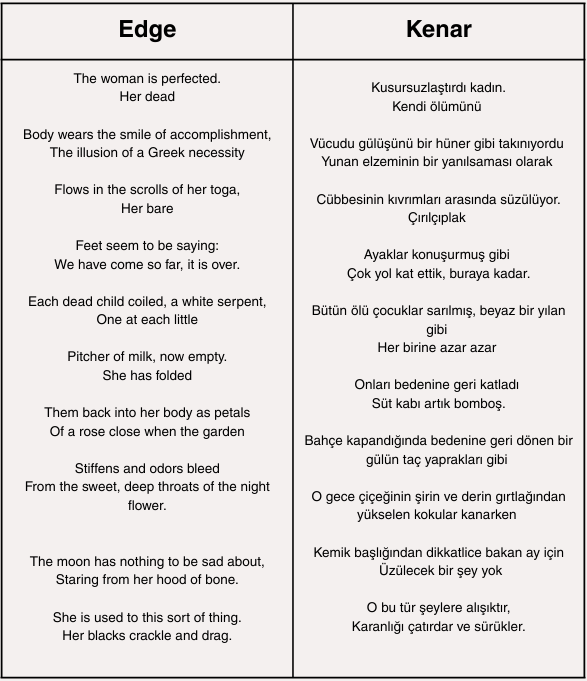
Edge was written in February 1963 and stands as one of her final works before her suicide. Composed during the last weeks of her life, the poem reflects a writing style that is strikingly restrained and controlled. Unlike earlier poems marked by emotional turbulence, Edge presents death with a calm, almost clinical tone, suggesting completion rather than chaos. The speaker's voice implies a sense of perfection, as suffering has been carefully arranged and resolved. Written under conditions of deep isolation and psychological pressure, Edge reveals Plath’s attempt to impose order on an overwhelming inner turmoil. Rather than seeking sympathy, the poem confronts the reader with the disciplined stillness of despair, exposing how finality and control can be mistaken for peace.

Here are the original poem and my translation:
References
- https://tr.pinterest.com/pin/418905202836694118/
- https://tr.pinterest.com/pin/1829656085503615/