From William Carlos Williams’ Poem to My Oil Painting: An Intersemiotic Translation
When we think of translation, the first image that comes to mind is usually a dictionary and words bouncing back and forth between two different languages. But what if I told you that moving from one mode of feeling to another is also a form of translation? When the sadness poured into lines by a poet is reborn on a canvas through brushstrokes, can we still be talking about translation? Roman Jakobson, the Russian-American linguist, describes this silent but profound transfer beyond the limits of language as “intersemiotic translation.”
So, what exactly is intersemiotic translation?
In his 1959 essay, Jakobson divides translation into three categories: intralingual, interlingual, and intersemiotic.
“Intralingual translation is an interpretation of verbal signs by means of other signs of the same language” (Jakobson, 1959, p. 233). This involves retranslating signs within the same language. For example, simplifying complex legal jargon written in English into plain English for the general public, or rewriting Shakespeare’s sonnets in Modern English, falls under this category.
“Interlingual translation is an interpretation of verbal signs by means of some other language” (Jakobson, 1959, p. 233). This form of translation is what usually comes to mind when most of us hear the word “translation”. According to Jakobson, translating a text from one language into another, such as translating an English book into Turkish, falls under this category.
“Intersemiotic translation is an interpretation of verbal signs by means of signs of nonverbal sign systems” (Jakobson, 1959, p. 233). In other words, it is the translation of words into a system outside of language, such as a painting, a film, or a piece of music. For instance, the adaptation of the novel Of Mice and Men into a film is a perfect illustration of this category.
Just as a translator aims to convey meaning rather than word-for-word accuracy in interlingual and intralingual translation, here too, the translator strives to capture the emotion, image, and rhythm through film, painting, or music. However, in this case, the translator’s keyboard is not made of letters but of colors and notes.
To view translation solely through the lens of language is like saying that music is nothing more than notes on a page, or that a painting is nothing but colors coming together on a canvas. Such a narrow view fails to account for the deeper ways in which meaning can be reimagined. Words are not merely sounds and letters; they are, at times, the shade of a color, the stroke of a brush, or the texture of a canvas. Capturing the fleeting images that are stirred in our minds when we read a poem and converting them into the tangible reality of oil paint is much more than just building a bridge between languages.
The epigram “Painting is poetry that is seen rather than felt, and poetry is painting that is felt rather than seen,” stated by Leonardo da Vinci, is a crystal-cut manifestation of the phenomenon (Goodreads, n.d.).
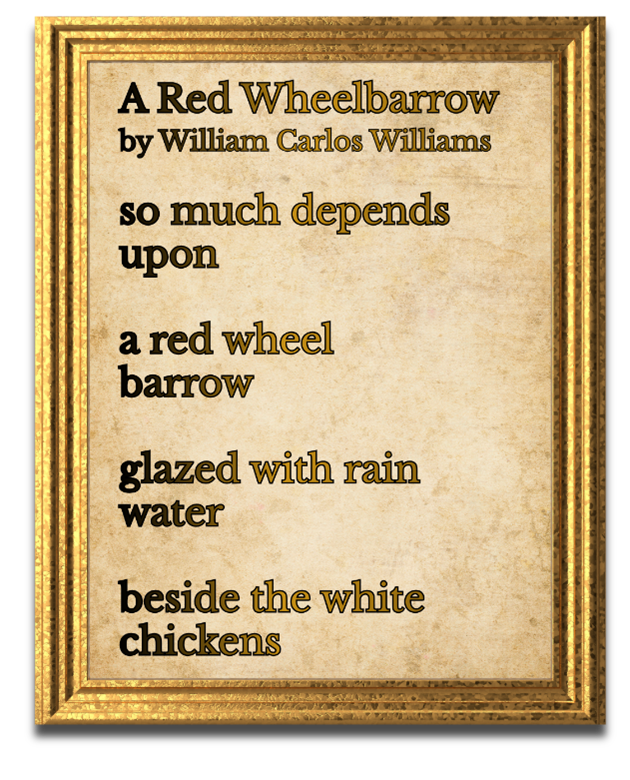
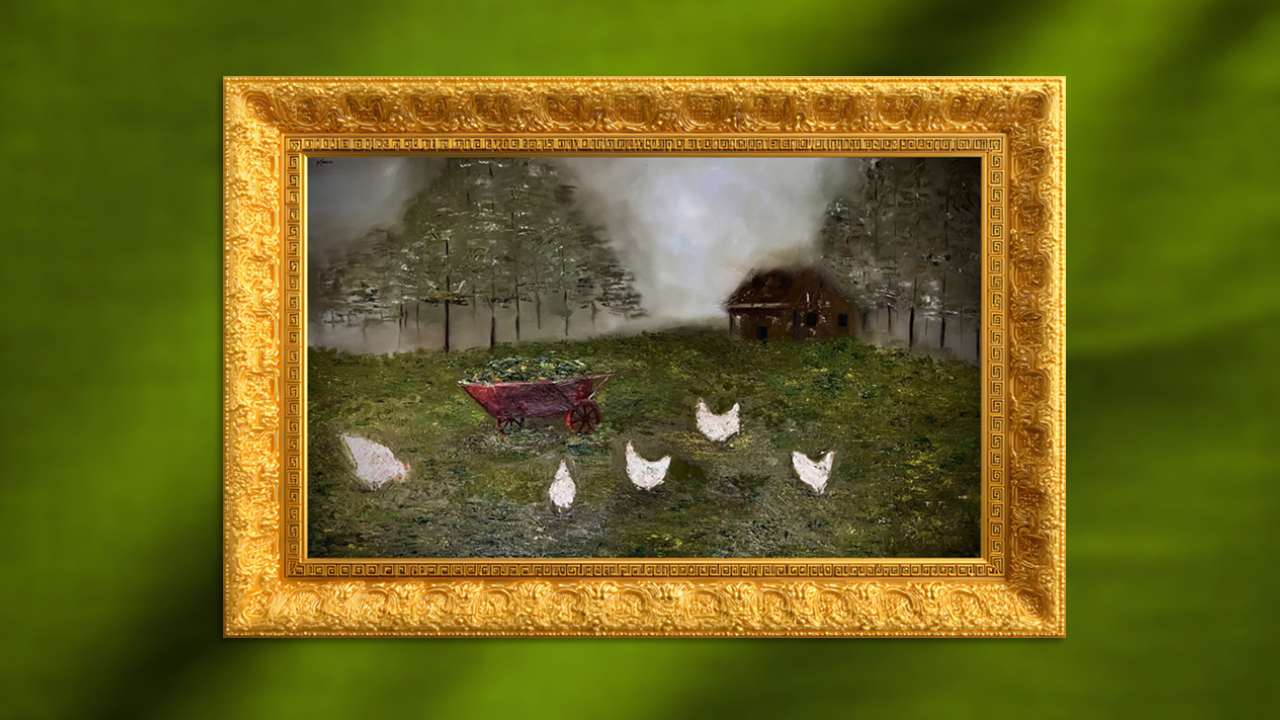
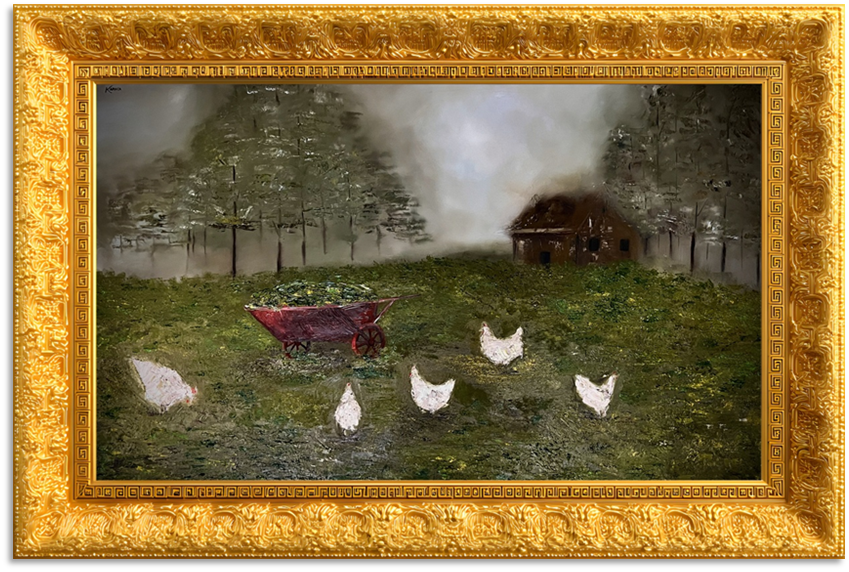
Inspired by this phenomenon, I have moved Jakobson’s concept of intersemiotic translation from the pages and given it a physical form, applying it to the canvas with the edge of my palette knife, a translation that stretches from William Carlos Williams’s poem, "The Red Wheelbarrow", to my own oil painting...
The first time I read these mere sixteen words, I did not see a text; rather, an image on a vast oil painting. What I wanted was to illustrate this image for the readers of this poem. To
better frame my translation choices, I aimed to touch upon the poem’s historical context before explaining the specific decisions I made during the translation. Just as historians must evaluate events within their original context rather than judging them by today’s standards, the translator, whose primary goal should be to convey emotion, must also master the period’s feelings and culture. By sharing this historical context, I aimed to help you see the poem through the same lens I used while translating it onto the canvas.
1923, the year this poem was born, was a year of wreckage. In the shadow of the First World War, the human spirit was lost in chaos and gloom. Old truths were shattered; faith in an orderly world had collapsed. Everything became more minimalist and focused on the essence. There was no longer any room for the unnecessary, neither in life nor in poetry.
This is why, as I read the line “glazed with rainwater”, the image of a sunny garden never crossed my mind. There was no light after the rain. Instead, I saw a desolate, misty forest, swamped with melancholy. My canvas, therefore, is not a place of warmth or a cheerful backyard; rather, a landscape of isolation, reflecting the same gloom that once haunted the era in which Williams wrote. At this point, my purpose was to translate this gloomy vision onto the canvas through my paints, capturing the mood of my mind as closely as I could.
With this vision in place, I had to decide on a translation strategy: the specific oil painting technique that would best express this gloom. In Europe, the interwar period was a holistic Modernist Era in which traditional molds were broken across all disciplines, ranging from philosophy to architecture, from painting to literature. At the same time, the impasto technique in oil painting reached its peak during this modernist movement. For this reason, I decided to translate modernist poetry into oil painting by employing the technique that modernism itself brought to the forefront: impasto.
Visualizing the poem's opening, “So much depends upon”, was one of my greatest challenges. I had to ask what exactly almost everything depends on. The next line gives us the answer: the red wheelbarrow. In my translation, the focus had to stay there. To convey this sense of “dependence” and “importance,” I used perspective to manipulate the sense of scale, rendering the house and forest as small, vague details in the distance. This deliberate choice makes the background recede, drawing all the focus onto the red wheelbarrow and the chickens in the foreground.
Then I found myself asking how to translate this red wheelbarrow. What did it truly represent? To me, it represents a grand cycle of life within a small tool. For a farmer, a wheelbarrow is more than a tool; it is the meaning of life that is at the centre of his very existence. It might carry wood to heat a house, water to ease thirst, and it becomes a child’s favorite toy. In short, what turns those wheels is not just the load, but life itself. From a broader perspective, the wheelbarrow is a symbol of a nation’s resistance and a concrete sign of financial freedom. For a society that grows its own food and grinds its own grain, this simple tool is the greatest weapon. Those wheels, turning in every village, are a reaction to dominance by others. As long as that wheel turns, we know there is still trust in the land and hope for the future. Because where there is production, there is hope; and where there is hope, there is a future. So, I painted the wheelbarrow in a vibrant red to make it pop against the misty background. By filling it with fresh grass instead of leaving it empty, I visualized the immense responsibility this small tool carries. In a world that feels misty and desolate, the red wheelbarrow is no longer just a tool; it has become a central figure, bearing the weight of survival and the continuity of life.
Translating the linguistic sign “glazed with rainwater” was my other greatest challenge. How could I evoke the sensation of wetness to anyone looking at the painting? To create that sensation of wetness on the red wheelbarrow, I used the palette knife not as a brush, but as a reflector of light. By applying white highlights over the vibrant red, I aimed to convey the feeling that a surface’s wetness still glistens after the rain.
In essence, with this translation, I aimed to recreate Williams’s poetic world using palette knife and impasto layers. This painting is not just an image of a poem. It is my interpretation to translate the soul and atmosphere of his verbal signs into a non-verbal system.
References
- Jakobson, R. (1959). On linguistic aspects of translation. In R. A. Brower (Ed.), On translation (pp. 232–239). Harvard University Press. https://web.stanford.edu/~eckert/PDF/jakobson.pdf
- Goodreads. (n.d.). Leonardo da Vinci quotes. Retrieved December 31, 2025, from https://www.goodreads.com/author/quotes/13560.Leonardo_da_Vinci
- Williams, W. C. (1938). The red wheelbarrow. In C. MacGowan (Ed.), The collected poems: Volume I, 1909–1939 (p. 224). New Directions Publishing Corporation.
AI Use
- AI assistance was utilized exclusively for checking grammar and syntax accuracy.