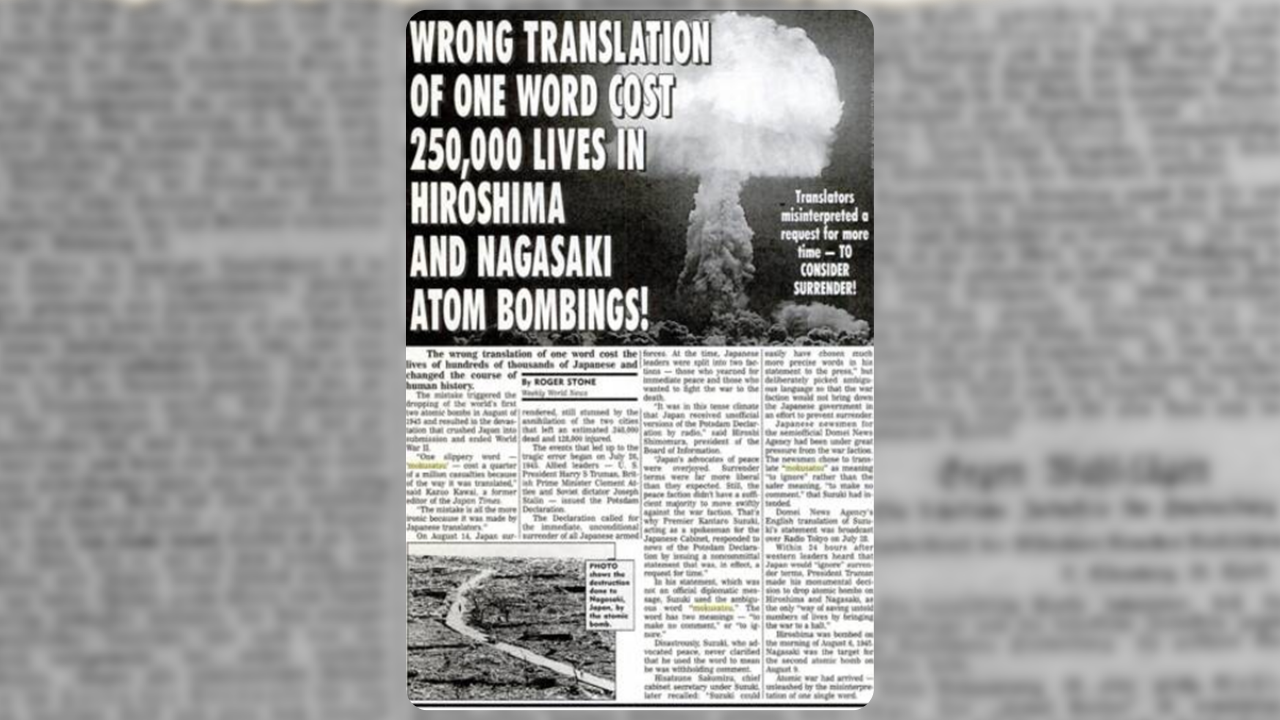
What Is the Ultimate Cost of a Translation Error?
What is the ultimate cost of a translation error? After all, it’s not as if it could lead to the atomic bomb. Or could it? When we open history books, we usually read that wars start because of land disputes, ambitious leaders, or massive economic crises. We are conditioned to look for huge reasons behind huge events. However, history sometimes hangs on a tiny choice made in a tired translator’s dictionary, or a single word interpreted incorrectly. Even one of the darkest events in human history, the dropping of the atomic bomb, may have started on the slippery slope of language rather than in a physicist’s laboratory. This is the tragic story of that single word: Mokusatsu. While this story is often told as a striking example of how a single word can influence the course of history, historians continue to debate the extent of its actual impact on the final decision-making process.
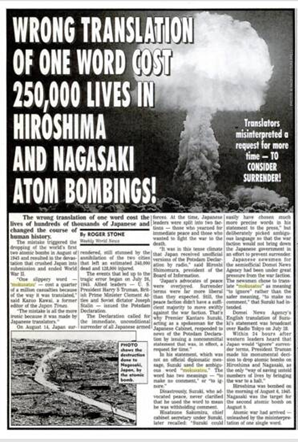
It was July 1945, and the world was holding its breath, waiting for the end of World War II. Allied leaders issued the “Potsdam Declaration,” giving Japan a clear and terrifying ultimatum: “Surrender unconditionally, or face prompt and utter destruction.” This was less a diplomatic offer and more a warning of a coming apocalypse. The Japanese government was cornered; they needed time to consult with the emperor and the military before making such a monumental decision. But the world press was impatient. When Prime Minister Kantaro Suzuki appeared before reporters in Tokyo, he was asked repeatedly: “What will you do about the ultimatum?” To indicate that no decision had been reached yet and he simply wanted to buy some time, Suzuki used a specific Japanese word: Mokusatsu.
The entire tragedy was hidden inside the nuanced and multi-layered nature of the Japanese language. Mokusatsu can have two very different meanings depending on the context. The first meaning which Suzuki intended was simply, “No comment for now, we are thinking about it.” However, the word also carried a much harsher definition: “To kill with silence,” or “to ignore with contempt.” Suzuki’s intention was innocent; he just wanted to say “no comment.” But history was prone to misunderstanding.
Under the immense pressure and speed of war, international news agencies and translators made a fatal error. They chose the aggressive, rejecting meaning instead of the passive, waiting one. When the message reached Washington, Suzuki’s “we are thinking about it” was translated with terrifying certainty: “We reject it entirely and ignore it.”
The United States saw not a statesman asking for time, but an arrogant enemy dismissing peace with a wave of the hand. While diplomatic channels were already under severe strain, this interpretation contributed to the perception that communication had broken down. In the following days, the decision to use atomic bombs was shaped by a combination of military, political, and strategic factors, within which this communication issue is often discussed as a contributing example. Hundreds of thousands of people lost their lives in the devastating aftermath of decisions shaped by war, where a sentence meant to ask for ‘a little time’ came to be understood as ‘we want war.’
Of course, historians continue to debate whether the war would have ended differently even with a correct translation. It must be emphasized, however, that the atomic bomb was not dropped solely because of this mistranslation; political, military, and strategic factors played decisive roles as well. But linguists agree on one thing: While it is unlikely that a single translation could have altered the course of such a complex war, the case of ‘mokusatsu’ remains a powerful reminder of how linguistic ambiguity can intensify misunderstandings in already fragile diplomatic situations. This event taught us, in the most painful way possible, that translation is not just moving words between languages, but building a vital bridge between cultures and intentions. This story, where words weighed heavier than nuclear weapons, is etched in memory as history’s saddest “linguistic error.” Therefore, rather than a single cause, the story of mokusatsu should be understood as a powerful illustration of how linguistic ambiguity can intersect with already complex political and military realities.
References
- Butow, R. J. C. (1954). Japan’s Decision to Surrender. Stanford University Press.
- Kawai, K. (1950). “Mokusatsu, Japan's Response to the Potsdam Declaration.” Pacific Historical Review.
- National Security Agency (NSA). “Mokusatsu: One Word, Two Lessons.” Declassified Technical Journal.
- Torchia, C. (2016). “The Mistranslation That Changed History.” The Associated Press.
Visual References
- https://www.letemps.ch/opinions/chroniques/mokusatsu-silence-de-mort
AI Use
- AI was used for language checking and augmenting the flow of the text.