One Word, One War: Mistranslations in the History of Translation
Throughout history, certain diplomatic incidents have frequently been linked to mistranslations or misinterpretations of key words and phrases. These stories continue to be widely cited in discussions about the power and risks of translation in international relations. However, while some cases reflect genuine linguistic ambiguities and cultural differences, others have been described by historians as partially exaggerated, simplified, or turned into enduring myths over time. The following examples illustrate how ambiguities in language, interpretation, and context have reportedly played a role in critical moments, even if the exact extent and nature of their influence remain subjects of ongoing historical debate.
What if wars do not begin with weapons, but with words? Or more precisely, with words that fail to arrive where they are meant to go. Long before modern diplomacy, international summits, or global media, the myth of Babel offered a striking explanation for chaos: people did not fall apart because they disagreed but because they could no longer understand one another. A shared language dissolved, meaning fractured, and cooperation became impossible. What followed was not merely confusion, but separation, mistrust, and the collapse of collective action. This ancient narrative still resonates today. In a world where political decisions are increasingly mediated through translation, words rarely travel alone. They carry cultural assumptions, ideological weight, and historical memory. When such words cross linguistic and cultural borders without sufficient translation awareness, they may transmit more than their surface meaning. They may also carry tension, fear, misalignment, and unintended hostility. Translation, in this sense, is not a neutral act of transfer but a fragile space where understanding can either be carefully negotiated or irrevocably lost. But is the problem that emerged in Babel truly a thing of the past? Or does it continue to shape the world we live in today? The historical cases discussed below suggest that misunderstanding born of mistranslation still surfaces at critical moments, often in political contexts where meaning is compressed, urgency is high, and ambiguity is costly. In such moments, a single word, pause, or interpretive choice may carry consequences far beyond language itself, sometimes severe enough to alter the course of diplomatic relations and global history.
Mokusatsu – Potsdam Declaration (1945)
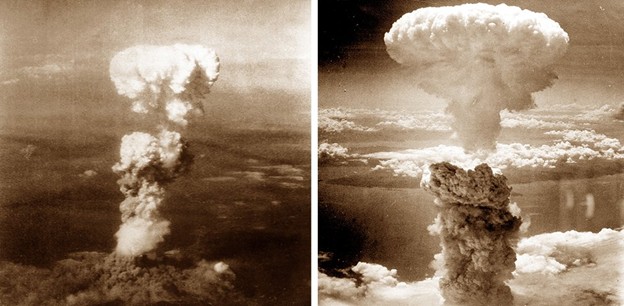
During the Second World War, the United States exerted significant pressure on Japan and issued a final call for surrender. In response to this call, Japanese Prime Minister Kantarō Suzuki used the term mokusatsu during a pressconference. In Japanese, mokusatsu can mean “to ignore,” “to treat with silent contempt,” or “to refrain from making a comment by remaining silent.” However, the American press and government translated the term as an “unconditional rejection” or a “contemptuous dismissal,” interpreting it as a definitive refusal to surrender. This mistranslation ultimately contributed to the United States’ decision to drop atomic bombs on Hiroshima and Nagasaki, resulting in the deaths of approximately 220,000 people. Although the Second World War eventually came to an end, this translationerror has remained one of the most significant diplomatic turning points in history.
Khrushchev “We will bury you” (1956)
In November 1956, during a farewell reception held in Moscow for Władysław Gomułka, the communist leader of Poland at the time, Nikita Khrushchev made the following statement:
“If you do not like us, do not accept our invitations and do not invite us to visit you. Whether you like it or not, history is on our side. We will bury you.”
In later years, Khrushchev repeatedly denied having used this phrase in the manner in which it was interpreted. He emphasized that he was not referring to the act of “burying” capitalism in a literal or physical sense. On 16 September 1959, when asked about the phrase “we will bury you” during a speech at the National Press Club in Washington, he explained:
“I did say this, but my words were deliberately distorted. What I meant was not the physical burial of anyone at any time, but the transformation of social systems in the course of historical development.”
Thus, Khrushchev’s intended meaning was an ideological metaphor suggesting that socialism would eventually replace capitalism, similar to saying “We will outlast you.” However, this expression was distorted through translation and interpretation. At times, it was also used to imply that capitalism would be destroyed in the event of a nuclear war. Themistranslation and misinterpretation of Khrushchev’s statement created significant diplomatic tension in the West and contributed to a critical turning point that intensified Cold War rhetoric.
“No Comment” – The Nixon & Zhou Enlai Translation Error (1972)
During President Richard Nixon’s visit to China, Zhou Enlai responded to a question after a brief pause by saying 没有意⻅ . The original meaning of this phrase is: “I do not yet have an opinion on this matter.” However, the Americaninterpreter translated it as “No comment.” In Chinese political culture, the phrase “no comment” is often interpreted as asign of complete closure on an issue or as a form of diplomatic rejection. This mistranslation led to a serious misunderstanding and caused a noticeable cooling in the atmosphere of the negotiations.
The Translation Impact of the Word “Students” – The Iran Hostage Crisis (1980)
On 4 November 1979, Iranian students seized the United States Embassy in Tehran and took 52 American personnel hostages, initiating the 444-day diplomatic crisis known as the Iran Hostage Crisis. U.S. President Jimmy Carterreferred to those involved in the crisis as “students.” However, when translated into Persian, this term was rendered not as “students” but rather as “young revolutionaries” or “militants.” This translation contributed to the breakdown offriendly relations between the United States and Iran. While the word “students” in English conveys a neutral and civilian identity, the Iranian groups described themselves as “Muslim Students Following the Line of the Imam” (Daneshjuyān-e Mosalmān-e Peyrow-e Khat-e Emām). In Persian public discourse, this label carried not only the meaning of “student” but also a revolutionary, anti-imperialist, and militant political stance. As a result, Carter’s softened and depoliticized language was reframed through revolutionary discourse when translated into Persian, leading the term “students” to be perceived as “young revolutionaries” or “militants.” The primary cause of this translationdifference lies not in linguistic meaning alone but in political and ideological contextual differences.
“A Declaration of War” After Pearl Harbor – The Japanese Note
Before the attack on Pearl Harbor, the Japanese government planned to deliver a notification to the United States that effectively functioned as a declaration of war. This message consisted of approximately 5,000 words and was transmittedfrom Tokyo to the Japanese Embassy in Washington. The document was heavily encrypted, and as a result, decoding and translating it into English took a considerable amount of time. Due to the inability of diplomatic translation personnel to decode and translate the message in a timely manner, the attack began before the notification reached Washington. The United States interpreted this situation as Japan having failed to provide prior warning before the attack. This perception strengthened the international view of the event as a “sneak attack,” since for many countries, the absence of priornotification was equivalent to the absence of a formal declaration of war. Consequently, the attack occurred while the two countries were technically still at peace.
Taken together, these historical cases reveal that the chaos imagined in the myth of Babel has never truly disappeared. The breakdown of understanding does not occur only when languages differ, but when meaning is rushed, narrowed, or prematurely fixed. In moments of political tension, words are rarely innocent. They travel through layers of culture, ideology, and expectation, and translation becomes the space where these layers either meet or collide. As the examples discussed show, mistranslation does not merely distort messages. It reshapes intentions, alters perceptions, and in certain contexts contributes to decisions whose consequences extend far beyond language. What begins as a single word, a pause, or an interpretive choice may gradually expand into suspicion, escalation, or irreversible political action. What emerges from these cases is a reminder that translation is not simply about linguistic accuracy but about how meaning is carried, interpreted, and acted upon. When understanding fails, the result is not just miscommunication but a form of historical rupture where words, once misread, can no longer be taken back.
References
- https://www.cia.gov/readingroom/docs/CIA-RDP73B00296R000200040087-1.pdf
- https://www.jimmycarterlibrary.gov/research/additional-resorces/hostage-crisis-in-iran
Visual References
- https://www.bbc.com/news/in-pictures-53648572
AI Use
- Language Editing