Glitch or Gift?
“Over the next decade, advances in artificial intelligence will mean that humans will no longer be needed ‘for most things’ in the world,” says Bill Gates (Capoot, 2025).
But does this prediction apply to the game localization industry as well? Will human translators eventually become extinct, or is there still something AI cannot replace? Of course, this was not always the case. In the early days of video games, localization was barely a concern, as games contained minimal text and relied mostly on basic visuals. However, as technology evolved, so did players’ expectations. Video games became more complex not only visually but also narratively, making localization an essential part of the gaming experience.
Since late 2022, AI’s impact across various industries has become too significant to ignore. Game localization goes far beyond translating on-screen texts from one language to another. It involves adapting dialogues, humor, cultural references, user interfaces, and even character personalities to fit the expectations of players from different linguistic and cultural backgrounds. A successful localization allows players to experience the game as if it were originally created in their own language. For this reason, localization is not merely a technical process but a creative and interpretative one, where linguistic choices directly shape player immersion and emotional and cultural engagement.
However, this creative dimension also reveals the limitations of both artificial intelligence and human translators. AI, despite its speed and consistency, often struggles with context sensitive humor, wordplay, culturally embedded references, and subtle emotional undertones that require interpretative judgment rather than direct equivalence. On the other hand, human translators are not without limitations either. Time constraints, cognitive fatigue, personal bias, and inconsistency can affect translation quality, particularly in large-scale projects with tight deadlines. In this sense, neither AI nor humans represent a flawless solution on their own. Nowadays, particularly with the growing impact of AI on the game industry, localization workflows have begun to change. Translators now benefit from AI tools in terms of both time and cost efficiency, especially during the early stages of localization. Tasks that once required extensive manual effort can now be completed more quickly, allowing teams to meet tight deadlines and reduce production costs.
Yet this shift raises a broader question: does the increasing use of AI in game localization represent a glitch that ends creativity or a gift that reshapes and simplifies? Opinions on this issue remain divided. While some view AI as a valuable tool that enhances productivity, others express concern over its potential to oversimplify creative processes and diminish the human role in localization.
Rather than replacing human translators, AI appears to be reshaping their role. Translators are increasingly positioned as creative editors, cultural mediators, and quality controllers who refine, adapt, and contextualize AI-generated outputs. In this emerging model, human expertise remains crucial in ensuring narrative coherence, preserving character voice, and maintaining cultural authenticity. AI may handle speed and volume, but human translators provide judgment, creativity, and humorous sensitivity.are increasingly positioned as creative editors, cultural mediators, and quality controllers who refine, adapt, and contextualize AI-generated outputs. In this emerging model, human expertise remains crucial in ensuring narrative coherence, preserving character voice, and maintaining cultural authenticity. AI may handle speed and volume, but human translators provide judgment, creativity, and humorous sensitivity.
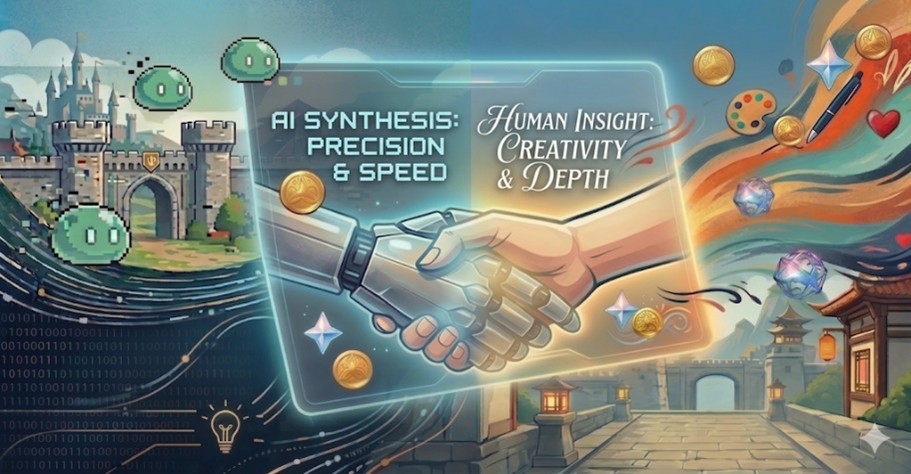
Ultimately, humans have always been at the center of creative production, while artificial intelligence, despite its growing impact on our lives, is still a relatively recent development. When a new tool, system, or design emerges with the potential to make human work easier, why should it not be used? Instead of viewing AI solely as a threat, it may be more productive to consider it as a supportive tool that assists human effort. As the saying goes, too much of anything can be harmful, but does that mean a deficient use must be harmful as well? Rather than asking whether AI can replace human translators, the more relevant question is how AI can be integrated responsibly into game localization workflows without sacrificing creativity and player experience.
References
- Capoot, A. (2025, March 26). Bill Gates on AI: Humans won’t be needed “for most things.”. CNBC. https://www.cnbc.com/2025/03/26/bill-gates-on-ai-humans-wont-be-needed-for-mos t-things.html
Visual References
- Generated by Gemini
AI Use
- Gemini and ChatGPT were used for content flow and text editing during the preparation of this aricle.